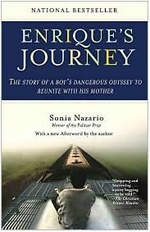
Enrique’s Journey by Sonia Nazario
Many Community Reads Programs select books about characters who live far different lives from most of their readers. National bestseller, Enrique’s Journey, a nonfiction account of a young Honduran boy setting out to find his mother in America, is one such book. Enrique’s Journey has already been selected by 58 universities and scores of high schools as a Freshman/All Campus Reads. It’s been adopted by nine cities as a “One City, One Book” selection. Pulitzer Prize winner, Sonia Nazario, answered a few questions for us about her book and its impact on communities throughout the US.
BIC: Why do you think Enrique’s Journey, is such a popular selection for All Campus Reads, and Books In Common type programs?
Sonia: Why has a book about a boy desperate to risk his life to reunite with his mother been such a popular choice for universities and cities? Students say they often see themselves in Enrique, because in coming to college they, too, must grapple with being away from their parents and families for the first time. They relate to a teen, a protagonist close to their own age, going through difficult circumstances, who steels himself with enormous determination to get where he needs to go. Educators say it is a compelling read, one that many students accomplish in one sitting, that broadens their awareness of cultures not their own. Teachers love that the story illuminates one of the biggest issues of our time—immigration—through one family’s experiences. The book broaches critical values: family, love, survival, diversity, racism, violence, drugs, redemption, and determination. Through a simple narrative, it engages students to think more globally. And it shows students that an issue often presented in black and white is instead highly complex, with many shades of grey. Enrique’s story provides no pat answers.
The greatest testament to students’ engagement is that so many of them become determined to better the situation described in Enrique’s Journey. They resolve to better the conditions that push so many women migrants to leave their home countries. They start micro-loan programs in Mexico and in Central America to help women start small businesses. They build schools and water systems there. They change their personal buying habits, purchasing fair trade coffee and clothing in an attempt to help women in those countries, so fewer of them feel forced to leave their homelands–and children–to work in the U.S. One Indiana University staffer was so moved to help she quit her job and opened a café in Honduras to create jobs for ten people there!
BIC: What do you think of the Community Reads structure as a literary event format?
Sonia: Communities across the U.S. are incredibly diverse. I’ve seen how Books In Common programs can begin to bring these diverse communities together to discuss one issue that affects them all. By sharing how they relate to the book, I’ve seen how people in a community can learn about their neighbors, can make connections they never would have otherwise made, or understand their neighbors better.
I think the best books for community reads provide ample opportunity for discussion and reflection, either about our values or the biggest issues of our time. I believe there is a tremendous value in taking some of the most politically controversial issues of our time, such as immigration, which can be incredibly polarizing, and getting people to discuss this issue in a community from different points of view. I have seen how that has helped people go beyond the extremes they hear from both sides on television to find common ground, to see immigration as I do: an issue with many shades of gray.
BIC: Would you share some notable experiences you’ve had at Common Read events.
Sonia: San Diego, CA: Enrique’s Journey was the first book San Diego picked for a Common Read. As I came to speak twice over the span of a few months, I was amazed by their ability to get everyone—Spanish and English speakers—involved (As with Denver, I think it helped that I could do media in both languages). KPBS, the main public television station, got everyone from the mayor to teachers and professors at six colleges from Tijuana, Mexico to throughout southern California to read and discuss my book.
I met the Crawford High School students who put together, with the help of KPBS producers, a 90-second video trailer for the book that won an Emmy.
Readers were not only eager to share the message of the book, but to also get involved. At La Jolla Country Day School in San Diego County, students launched a campaign to raise money—more than $9,000.
Denver, CO: Metro State student Sherri Thomson-Pemberton was raised to focus on how illegal immigrants were stealing American jobs and “don’t deserve a chance to live in ‘my country.’” She wrote me: “All of the assumptions I have grown up with or been told to believe have been shattered” after reading Enrique’s Journey. “I look at immigration in a whole new way.” Angela Furney, another Metro State student, said: “Judging a group of people becomes much more difficult once you know one individual from that group.” For her, that individual was Enrique.
Laredo, TX: I had been in Laredo, Texas, twice to report Enrique’s Journey. This time I was returning because the city had chosen Enrique’s Journey for its “one city, one book read.”
At the airport, four ladies greeted me. One was the high school librarian (Carmen Escamilla), two were English teachers (Annie Trevino and Beverly Herrera), and the fourth was the local bookseller (Mary Benavides). They came in a stretch white limo with disco lights inside!
For two days, these wonderful book-lovers and I cruised the city. They hustled me from one venue to another, and at the end of my brief time in Laredo I had spoken to about 4,000 people.
This in a city of some 200,000. It was overwhelming–and wonderful.

